
Bandiagara cliffs
By Samson Mawulolo Ahlijah
In 1969, the famous Swiss author Erich von Däniken published Chariot of the Gods, which was published the same year in French under the title La présence des extraterrestres by Éditions Robert Laffont. This book, which continues to sell thousands of copies today, popularised the ancient astronaut theory. This theory, which is considered heretical by the orthodox scientific community, attempts to explain the technical prowess of ancient civilisations by possible contact with extraterrestrials. For the defenders of the ancient astronaut theory, the celestial chariots driven by the gods in many mythologies are in fact what we call UFOs today. And if the Egyptians, Mayans and many other peoples were able to erect such great edifices, it was because they had the help of an intelligence from outer space. Some proponents of the ancient astronaut theory go even further. For them, all these buildings were constructed by one or more extraterrestrial civilisations. Humans would only have been small hands in the realisation of these gigantic works.

While the theory of ancient astronauts may seem far-fetched, it cannot be scientifically dismissed out of hand. The explanations given by the traditional scientific community to explain the prowess of hidden civilisations are far from satisfactory. With the technical and technological resources available to mankind today, building the Great Pyramid of Cheops remains a difficult, if not impossible, undertaking. How could people whose only tools were hammers and chisels succeed where powerful modern machines fail? Were the ancients more advanced than contemporary history would have us believe? Or has there really been contact with aliens? Answering this question with certainty remains impossible for the time being. But in the depths of the African continent, there are some strange facts that challenge us and can guide us along the path to truth.
One of the special features of Africa is the incredible diversity of peoples who have lived there for thousands of years. It is estimated that between 2,000 and 3,000 ethnic groups share the continent. These nations all have their own languages, their own cultures and, most importantly, their own origins. Some stories are particularly interesting because they seem to point to potential contact with beings from elsewhere, or better still, extraterrestrial descent.
The Dogon nation and the star Sirius

Dogon Sculpture, Louvre Museum, Paris
In Mali, on the cliffs of Bandiagara, live a mysterious people: the Dogon. Famous for their masks, the Dogon are also excellent hunters and warriors who are at the forefront of the fight against jihadists and Islamic insurgents.
If the Dogon people are one of the best-known African nations in the world, it is undoubtedly because of their profound knowledge of the sky and the stars. The French anthropologist Marcel Griaule and several authors who came into contact with the Dogon people in the early 20ᵉ century realised that traditional Dogon religion incorporates quite precise details about extrasolar astronomical bodies. None of these facts can be observed with the naked eye.
From 1931 to 1956, over a period of more than 20 years, Marcel Griaule studied the Dogon and spoke extensively with the Dogon sage Ogotemmeli. Ogotemmeli told him that for his people, the brightest star in the night sky is Sigi Tolo or Sigui star, which corresponds to the star Sirius A. This star has two companion stars, namely Pō Tolo, which is the star Digitaria (Sirius B), and ęmmę ya tolo, which corresponds to the female star Sorghum (Sirius C). These two stars are respectively the first and second companions of Sirius A. In the Dogon system, Sirius formed one of the foci of the orbit of a small star that is none other than the companion star Digitaria. When Digitaria is closest to Sirius, this star lights up. When it is furthest from Sirius, it emits a twinkling effect that suggests to the observer the presence of several stars. The orbital cycle lasts 50 years.
In addition to Sirius A, the words of the wise man Ogotemmeli also indicate that the Dogon have a good knowledge of Saturn’s rings and Jupiter’s moons.
There are three main reasons why the Dogon people have this knowledge.
Reason 1: contact with the West
The first reason, defended by traditional scientists, is that the Dogon nation acquired this knowledge of the sky through contact with Europeans. Astronomer Ian Ridpath suggests that « there are many channels through which the Dogon could have received Western knowledge long before they were visited by Griaule ». In his book Sirius Matters, Noah Brosch postulates that the Dogon may have had contact with astronomers based in Dogon territory during a five-week expedition led by Henri-Alexandre Deslandres to study the solar eclipse of 16 April 1893.
While these arguments have the merit of conforming to the framework of thought in which the conventional scientific community is immersed, they have a hard time convincing many researchers.
Dogon society is deeply initiatory. In other words, knowledge is passed down from generation to generation within very closed secret societies. The chances of Western knowledge having been incorporated into the metaphysical system of this people to the point of becoming the cornerstone of their relationship with the invisible are slim to nil. What’s more, how many European explorers spent their time discussing astronomy with African peoples who, in their eyes, were (for the most part) savages just emerging from the prehistoric era? The third argument that weakens this first explanation is this: if astronomical knowledge was exchanged between Europeans and the African populations of the Niger loop region towards the end of the 1800s, why is there no trace of this information among other peoples? Were the Dogon a major exception? If so, why? And furthermore, why have explorers or various scientific teams not indicated that they exchanged such information with this people?
Reason 2: an ancient civilisation
The second explanation that could justify the Dogon people’s knowledge of the star Sirius and the moons of Jupiter is that of an ancient civilisation whose heirs the Dogon are. The problem is that the chronicles of the Dogon people make no such mention. Nor does anything seem to indicate that in the vicinity of the Bandiagara cliffs there once existed a civilisation that had the technology to observe the stars.
Reason 3: extraterrestrial contact
The third explanation, defended by supporters of the ancient astronaut theory, consists of explaining the knowledge of the Dogon people by an encounter with extraterrestrials in the very distant past. Some go even further and maintain that the Dogon are descendants of a people from the stars, or at least the result of a hybridisation between such a people and humans.
The absence of material evidence prevents us from confirming this third hypothesis. But one thing is certain: the astronomical knowledge of the Dogon seems to surpass our current knowledge of the sky in many areas. At present, many astronomers are beginning to suspect the existence of a third star, none other than Sirius C, orbiting Sirius A and causing a change in colour. The same colour change that the Dogon spoke of. What’s more, for this age-old African nation, the question of extraterrestrial life has been settled for a very long time. The Dogon are convinced that in the infinite universe, there are infinite inhabited worlds moving away from the earth at very high speeds in a spiral motion. The wise Dogons also assert that these spiral movements are also found in the infinitely small human beings. In other words, the infinitely large – the planets, solar systems, galaxies and milky ways – have the same configuration as the infinitely small – the cells, molecules and atoms that make up our bodies. This observation surprisingly echoes a very famous phrase in initiation societies: what’s below is like what’s above!
The Aja-Ewe nations
On the coast of West Africa, in the Gulf of Guinea, lies an African nation with a rich past. The Éwés, who today live in Nigeria, Benin, Togo and Ghana, are related to the other nations occupying this geographical area, namely the Fons, the Ajas and even the Yorubas. The chronicles of the Éwés people trace the origins of this nation back to the ancient Yoruba city of Ilé-Ifé in the centre of present-day Nigeria. It is said that it was from here that the people migrated westwards following political disagreements with their neighbours, ending up in the town of Tado. It was from this city, in the 15ᵉ and 16ᵉ centuries, that the people who founded the kingdoms of Porto-Novo and Dahomey left.
Although the Ewe chroniclers do not all seem to agree on the path taken by this nation to end up in the ancient city of Tado, they are unanimous on the role played by one figure in the birth of the Ewe identity: Togbui (ancestor) Anyi.
There are many different stories about the origin of Togbui-Agni. But one in particular deserves our attention. In an academic note on the accounts of the founding of the Aja-Tado kingdom in southern Benin, Michael Houseman states that in a secret version of the story of Togbui-Agni, said to have been told by one of the kings of Tado, Togbui-Agni was born of two beings who were not men.
This little-known version of the story raises a number of questions. Who were these non-human beings from whom Togbui-Agni was said to have been born? The metaphysical system of the Aja-Ewé peoples makes a clear distinction between spirits and humans, as well as beings of the four elements (water, earth, fire and air). If Togbui-Agni’s parents belonged to one of these categories, this would have been clearly mentioned. We can assume that the qualifier « non-human » used in this case refers to intelligences from elsewhere, and why not to extraterrestrials.
Admittedly, unlike the Dogon people, the nations of the Aja-Tado cultural area do not seem to have a profound knowledge of the stars. However, several of these peoples claim to have descended from the heavens. To establish the kingdom of Dahomey, the people subjugated a people called the Djinu, which literally translates as those who fell from the sky or sky people. They claimed to have come from the sky. Is this a legend fabricated to justify domination over other peoples, or proof of contact with extraterrestrials in the distant past?
More than 500 kilometres from where the Djinu lived, another people, the Kabyès, also believe they came down from the sky. The footprints still visible in Farandè are presented by the wise men and elders of this tribe as proof of their celestial ancestry.
Amazulu: the people descended from the sky

Kwazulu-Natal
The history of the Zulu people is best remembered for the brilliant military campaigns led by Shaka KaSenzangakhona. Having inherited the throne on the death of his father, the man who is sometimes compared to the French hero Napoleon Bonaparte expanded his country’s borders and inflicted several setbacks on the European invaders. However, what interests us here is not Shaka’s extraordinary military exploits, but rather a legend to which the Zulu people seem to be very strongly attached. This legend traces the origins of the Zulu people back to the sky.
Indeed, the Zulu consider themselves to be the people of the sky. This nation does not claim a certain sanctity or a particular proximity to a divinity whose dwelling place is the sky. The Zulus believe that their first ancestors descended from the sky. Once again, there is no material evidence to support the unequivocal assertion that the Zulus are a people of extraterrestrial origin. For many researchers, these claims by the Zulu people refer rather to a migration from the north (Egypt?) to the south, i.e. their current location.

Credo Mutwa
But the words of the great Zulu Shaman, Credo Mutwa (1921-2020), seem to point in a different direction. In numerous interviews, this traditional Zulu priest indicated that the elders and wise men of this people had a good knowledge of extraterrestrials. He particularly emphasised the presence of malevolent extraterrestrial races on Earth and in several African countries. The Zulus are perhaps a nation that, in the very distant past, had a link with non-human beings from elsewhere.
The Ubang nation and the footprint of God
In south-east Nigeria, not far from the border with Cameroon, lies the Ubang nation. The Ubang are one of the smallest ethnic groups on the African continent, but also one of the most fascinating.
The Genesis of the Ubang people is clear on one subject: the Ubang are the first people created by the Divine. According to the chronicles of the Ubang people, God first created the Ubang men and women, giving them each a specific language. The Creator then realised that this was a mistake and chose to give the other peoples of the earth a single language for both men and women.
The surprising thing is that even today, the men and women of this African nation do not speak the same languages. And beware! It’s not just a difference in pronunciation between men’s and women’s languages. The names of many everyday tools and objects are radically different for men and women. For example, while the Ubang woman calls a dog Okwakwe, the Ubang man calls this domestic animal Abu.
And yet women and men understand each other, because the men speak the women’s language. The reason is that in traditional Ubang society, boys grow up alongside their mothers. But around the age of 10, something strange happens. The boys start to speak the language of men, which is a sign of their maturity. « There is a stage when a man will reach and discover that he is not using the language that belongs to him. No one will tell him that he should adopt the male language, » a wise man from this nation told the BBC. « When he starts to speak the language of men, you know that maturity is coming into him. If a child doesn’t use the right language at a certain age, it’s considered abnormal, » he said. So there doesn’t seem to be any specific transmission of man’s language or conventional learning of it.
No explanation has yet been found to justify this difference in language between the men and women of the Ubang nation. While the mystery of this particularity intrigues many, the Ubang have another specificity that suggests that this people came into contact a very long time ago with an intelligence from elsewhere.
The Ubang say that to prove to humanity that they were the first beings created, God chose to leave his imprint on one of the mountains in the region they occupy.
This statement indicates that there is a non-human footprint on the mountain in question. This footprint would therefore be that of the creator of the Ubang nation, or at least of a creature that the Ubang consider to be such. We have never personally seen this footprint. However, it is possible that it could be the footprint of an extraterrestrial who passed through the region a very long time ago and played an important role in the formation of the Ubang identity. Seen from this angle, the differences between the languages spoken by men and women could perhaps be the result of an experiment initiated by this being from outer space.
Of course, there is no material evidence to corroborate this hypothesis, and the mystery of the Ubang people seems set to remain unsolved. In the meantime, if you want to ask an Ubang man for a piece of clothing, use the word Nki, and if you’re talking to a woman, use the word Arika.
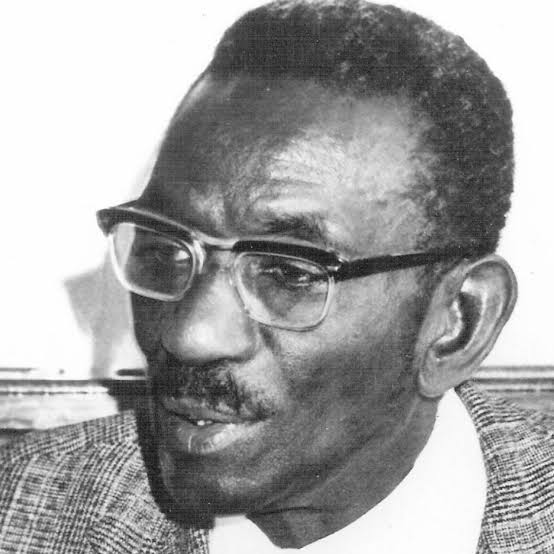
Cheikh Anta Diop
It’s time to take a serious look at the ‘legends’ that have shaped the destiny of millions of Africans, because they very probably contain some truth. It remains to be seen whether, for example, our African archaeologists will show the open-mindedness and, let’s be clear, the daring that is sorely lacking in many Western archaeologists (just think of the way the writer Graham Hancock has so often been smeared by the archaeological world). On the continent where Cheikh Anta Diop was born, there is always hope.




 UAP AFRIQUE
Laisser un commentaire