
by Tristan Routier – June 2024
For some years now, interest in the subject of UFOs has been revived beyond the realms of the supernatural and the impossible, where it was generally confined. There are several reasons for this gradual normalisation, which has led to the phenomenon being de-stigmatised, particularly in media and academic circles.
Firstly, the lexicon used for decades has gradually evolved to give the issue a more serious character. The term Unidentified Flying Object, which often implied the extraterrestrial hypothesis, has gradually been replaced by the more consensual term UAP (Unidentified Aerospace Phenomenon), which takes into account the atmospheric phenomena that were often the cause of some of these sightings.
Then, current events vindicated the proponents of the existence of a mystery that was attracting the attention of governments. On 16 December 2017, the prestigious New York Times published an article revealing that the US Department of Defence had spent 22.5 million dollars on a secret programme called the Advanced Aerospace Threat Identification Program, the aim of which was to investigate UFOs.
The months that followed were punctuated by statements from former US military and intelligence officers, as well as the release of videos from the US Department of Defence showing so-called UFOs (for these are indeed physical objects) filmed by cameras fitted to military aircraft.
This was all the more reason for other organisations, such as NASA and universities such as the prestigious Harvard University, to also take up the issue of UFOs, thereby definitively de-stigmatising them on the other side of the Atlantic.
In Europe too, the idea that unidentified objects can cross our airspace is gaining ground. This is borne out by the many articles, conferences and debates in which leading figures from the worlds of civil aviation, intelligence and research have taken the floor. The idea of the existence of UFOs is certainly not unanimous, but the subject is tending to gain in credibility, particularly as a result of the contributions of people renowned for their professional backgrounds.
The situation is quite different, however, when you cross the Mediterranean. While the subject of UFOs has made its mark on people’s minds in Asia and America(1), the situation is quite different in Africa, where the issue is non-existent in the public debate and even more so in the world of research.
But if the subject of UFOs is non-existent in Africa, is it not because it is part of such an obvious reality that there is no point in talking about it? In particular, we might wonder whether the UFO question is not intrinsically linked to the question of the invisible, the supernatural. And yet, on the African continent, the invisible is an everyday reality. The invisible accompanies man throughout his life, materialising in a series of rites and customs designed to remind us of its existence and its impact on the destiny of living beings.
In such a context, could it be that UFOs and their mysteries are not considered ‘unbelievable’ by many Africans, or at least no more unbelievable than the mysteries of vodun? They would fit into a system of thought, they would have a place, they would be interpreted in certain terms.
We can therefore assume that understanding the UFO phenomenon in Africa must be viewed through the prism of the « mysticism » specific to each of the continent’s civilisations and cultures. We therefore need to investigate these local specificities to find out how they think about them, integrate them and explain their presence.
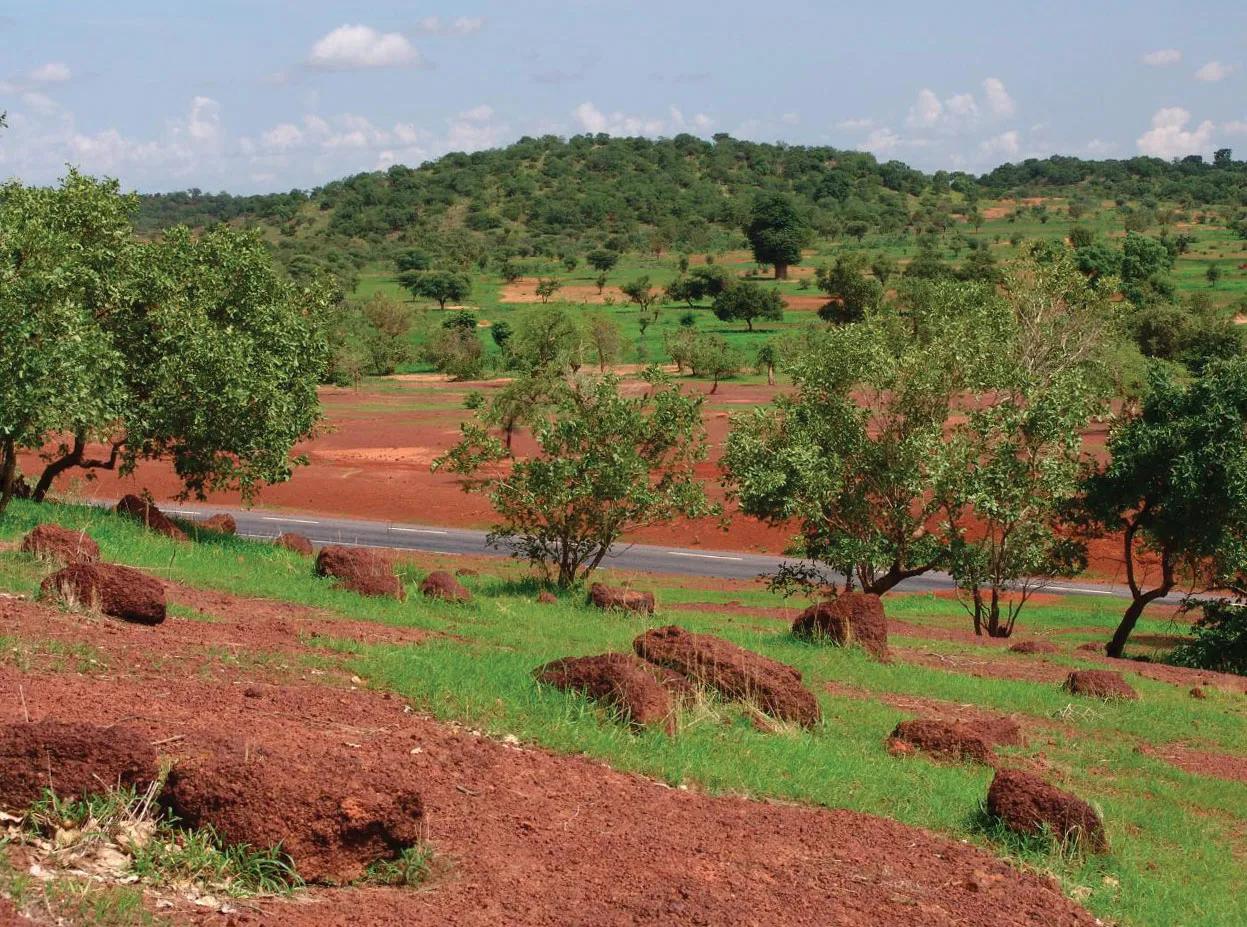
Let’s take the case of Mali, a country with a thousand-year-old historical tradition preserved thanks to the knowledge of traditionalists (griots jeliw and gesere) and then transcribed and analysed by historians and anthropologists. Through the vernacular religious prism, we will attempt to consider the UFO phenomenon based on an observation made in the 1990s by an inhabitant of the village of Kela, in the Mandé region of Mali.
Located about 80 kilometres from Bamako, the village of Kela occupies a special place because of the position of its griots. These griots play a very important role in Manding culture, as every seven years they celebrate the ‘official’ version of the story the epic of Sunjata Keita at the septennial Kamablon ceremony held at the Kamabolon shrine in the town of Kangaba, 5 km from Kela. For this reason, Mandingo griots often refer to Kela as the source of their knowledge. It is a place steeped in knowledge and mystery.
This story was told to me in 2004 by Mamadou Ba Kamissoko, a griot living in Kela. At the time, I was doing a field placement as part of my research into medieval African history on « Mandingo royalty between the 13th and 15th centuries ».
« When I was a child, I often went down to the river to buy fish and then sell them in Kangaba to supply the buffets in Bamako’s restaurants and hotels. I’d take the 2km path down to the River Niger and wait for the fishermen to come back, hoping for a good catch. That evening, the fishermen took a long time to return, and I had to go back when it was already dark. I was 13 or 14 and I’d already made the journey at night. But nothing had prepared me for what I was about to see. After 30 minutes of walking, when it was pitch black and I was approaching the village, I was dazzled by a red light that seemed to emanate from the top of a tree. It was an old tree, like those known as ‘djirimasa’ or ‘king trees’. The elders say that these trees sometimes shelter djins or wokloni(2).
I was dazzled by this red light, a djin, and I ran to get away from it, but it reappeared in front of me, forcing me to turn around. I kept running, letting out a scream, until I reached the village. I then took refuge in my hut. That’s how it happened the first time.
Then I saw the same djin again just behind my hut, still at night. In those days there weren’t many people in the village. I have the impression that the djin, like the wokloni, don’t like it when there are people around. They prefer to show themselves in isolated places, away from people. But as soon as there are motorbikes or cars around, they’re out of sight. It’s as if they don’t like the smell of fuel.
It is said of the djin and wokloni that they can change shape and take on the appearance of a child. Sometimes their eyes glow with a red light, which is really frightening. I’ve also learnt that some of these devils can blind you. What’s more, when they appear in their luminous form, they sometimes leave a scorch mark on the ground.
While a number of elements stand out in this account, three are particularly noteworthy: sightings of red lights, djins and wokloni.
Sightings involving red lights are recurrent in UFO stories. In France, for example, several similar phenomena have been recorded(3).
As far as djins and wokloni are concerned, they feature very frequently in West African fantasy literature, but especially in cosmogonic accounts recounting the creation of the world and the appearance of humans. But before developing these two elements further, let’s return to the testimony of another individual, anonymous this time, Lansine D., a 36-year-old farmer who also lives in Kela.
« I saw a wokloni when I was 23. It happened in the very heart of Kela in the middle of the night. I was returning with some friends from a ceremony that had taken place in another village. I remember arriving in Kela and there was nobody there. Suddenly we saw a short figure with long hair. I asked him what he was doing there. He pointed a finger in the direction of the huts as if to say that he came from there. But I knew the children in the family who lived in those huts and I told him he couldn’t have come from there. He then turned away from me and suddenly ran off. I remember seeing his long hair as I ran after him, but I couldn’t catch him. That’s when I realised it was a wokloni. They have a habit of entering the village and breaking into the huts where there’s food. I think they’re looking for water and peanuts.
As for wokloni in the form of lights, I’ve only seen them once. It was in a field. It was night-time and I was cycling back from a nearby village where I’d been for a baptism. I was accompanied by 4 friends. We had just left the tarmac to take the path that leads to Kela and suddenly, as we passed under a large tree, we saw a red light above us. We got scared and accelerated towards Kela. The light stayed on the tree but projected a beam of light in our direction. This light followed us until we entered the village. It felt like the light could follow us for miles. Fortunately nothing else happened. Because I’ve heard stories of people being hurt by these lights. Sometimes the light falls, like seeds, from the top down, and that’s what hurts ».
In this second story, we find the term wokloni again, but it seems to refer sometimes to an individual resembling a child, and sometimes to a luminous phenomenon that appears in certain trees. We shall see that the term refers to recurring esoteric traditions in the Sudano-Sahelian region, and that it appears in several cosmogonic narratives in Senegal, Mali and Niger.
At the « Second Bamako International Colloquium of the SCOA Foundation for Scientific Research in Black Africa », held in Mali in February 1976, a scientific event that brought together historians, anthropologists, archaeologists, linguists and traditionalists, historian Djibril Tamsir Niané drew a link between the notions of djin and wokloni: « As far as I know, the word Djinn, Djinna, is very widespread among Muslims and animists in Black Africa, but there is another word that corresponds to Djinn in Malinké, the word wokolo. « .
These comments are supplemented by those of Professor Wa Kamissoko, who explains that: « In Mande, there are 5 types of genius with different names. They are: the Nyama, the Sigifen, the Konkoma, the Gwere, the Wokolo of the Bambaras and finally the Bilisi. These are the 5 types of genius known in Manding and they are totally different from each other ».

Lastly, historian Youssouf Tata Cissé adds the following clarifications: « the Nyama are these geniuses who manifest themselves in the form of heat or the movement of generally hot air. As for the Sigifen (from sigi installer, and fen chose), they could be called ‘place geniuses’; then there are the Konkoma who appear in the form of points of light, flames or trails of flames; hunters are familiar with these nocturnal manifestations that are frequent in the bush and more particularly on the plateaux. Then there are the gwere, the little men (elves?) who have their feet upside down, and the Bilisi.
The terms djin and wokloni thus seem to refer to entities that are sometimes similar and sometimes distinct. Moreover, the terminology seems to be used by several communities.
A few years later, at the « first international seminar of the SCOA Association in Niamey » in January 1981, Youssouf Tata Cissé returned to the terminology used to designate these mysterious beings: « Among the Malinke and Bambara, the ‘dwarf’ or goblin goes by three and even four names. They are called wòkulò or wòkulònin, ‘the being or little being of the hollows’; gòtè, ‘the shrivelled one’; gwèrèn or dèndèrèni, ‘the condensed one’; mangusi, a variety of dwarf living in the bowels of the earth. These dwarfs play a key role in Manding beliefs and mythology; they are said to have forward-facing heels and a large head.
Other researchers, such as Professor Kélétigui Abdourahmane Mariko, consider wokloni to be very real beings, based on the founding stories of certain communities. Referring to the traditions of the Kagoro people of Mali, he says(4): « When they arrived in the places they now occupy, their ancestors found little red men, dwarfs, who they drove away to the south-south-west. I didn’t understand Malinké very well at the time – but later, from the names they gave to these dwarves, I understood that they were woklo, i.e. either ‘goblins’ or ‘negrilles’. They were talking about the gotenin who, according to the hunters, are small, hairy anthropomorphic geniuses who live in the hollow trunks of certain large trees, and who give hunters who do them a favour the secrets they need to summon game ».
He goes on to establish a link with the Nyamnyam of Hausa country: « The Kagoro described these Woklo and Gotenin as cave-dwellers. If we compare the traditions of Zinder relating to the country’s first occupants with those of the Malian Kagoro, the similarities are striking. Those whom the Hausa-speaking inhabitants of the Damagaram or Sultanate of Zinder call Nyamnyam correspond to the « little red men » of the Kagoro. The Hausa Goïgoï corresponds to the Atakurma of the Songhay Zarma, the Woklo and Gotenin of the Kagoro and Mandings. The term given by G. Dieterlen, goloma, also corresponds to the term nyamnyam of the Hausa country.
Throughout Hausa country, traditions and legends present the same versions of the country’s occupation by four successive peoples, from its origins to the Fulani, Tuareg and European invasions. Even today, in the caves of Korgom, south of Tessaoua, between Niger and Nigeria, live cave-dwellers who are said to be the descendants of the dwarves known there as shurrubawa ».

This brings us back to the idea that the wokloni, also known as woklo, atakurma or nyamnyam depending on the region and the language, is a being with supernatural powers who sometimes interacts with human beings, particularly hunters, as the holders of certain secrets. More interestingly, these same wokloni are thought to have played a role in the history of the settlement of the Sahelian regions, as anthropologist Filifing Sako explains: « In the meantime, let’s remember what everyone knows, namely that from the primary to the quaternary period, the African continent experienced emersion zones, and that during the quaternary period, when man was born and evolved, negroids inhabited the north of Africa. And it has been proven that the Sahara desert was once, if not a sea, at least a very large lake, and that as this area dried up, the human groups that inhabited its shores and islands retreated in successive waves southwards, towards the forest, the primordial habitat of the pygmies. So the wokloni dwarfs of the Bambara and the atakurma of the Songhay-Zarma would be the « mythical memory » of these little men who really existed and who would have been the first men to leave the state of nature to enter the state of civilisation, of culture. We know the rest of the story: the arrival of the great Negroes, followed much later by that of the Berbers and finally the Arabs, I mean the Moors ».
According to Professor Filifing Sako, these beings are a mental construct, derived from the « mythical memory » of the first inhabitants of the Sahel before desertification, populations that are similar to the pygmies of Central Africa. West Africa also has pygmy populations divided into a multitude of very different tribes. According to a study carried out at the end of 2010 by eight laboratories from the CNRS, the National Museum of Natural History, the National Institute for Agronomic Research (INRA) and the Institut Pasteur, the pygmies of West Africa may have had a common ancestor more than 54,000 years ago, and the start of their fragmentation into various settlements dates from around 2,800 years ago.
These data allow us to approach the notion of wokloni from a much more down-to-earth angle, which would suppose that they are a representation common to various African peoples, referring to a distant past before the so-called ‘classic’ populations settled in several regions of the continent. Of course, this does not shed much light on the veracity of the stories mentioned above, which attribute extraordinary abilities to these beings and representations that directly echo UFO or UAP sightings in other latitudes.
This does not shed any more light on the red lights, which also seem to be part of folklore, particularly in Mali, if we are to believe the testimonies of the people interviewed. Could it be that these sightings correspond to the Konkoma mentioned by traditionalists, an entity that appears in the form of points of light, flames or streaks of flame? Can recurrences be established in other countries on the continent?
It would therefore be worth continuing the investigations by extending the research to Central Africa, East Africa and Southern Africa, in order to check whether such phenomena have also been reported and whether cosmogonic accounts mention such creatures or such manifestations. Obviously, this type of research requires the involvement of related disciplines, such as linguistics, anthropology and archaeology, in order to compare historical data that is often fragmentary.
We will see in other articles that the UFO or UAP phenomenon is treated almost systematically in Africa from a religious or mystical angle. We therefore need to call on the knowledge of specialists in endogenous religions and followers of these same religions, in order to draw up a phenomenology that can be compared with that relating to UFOs.

Tristan ROUTIER holds a Master’s degree in Anthropology and Social Ethnology from EHESS and a Master’s degree in Ancient African History from the University of Paris 1 Panthéon Sorbonne. He specialises in decentralisation and local development in Africa. He has worked as an adviser to several African states on governance issues (Benin, Mali, Togo and Cameroon) for the past ten years.
Passionate about the continent’s pre-colonial history, he is also working on a number of projects in the fields of art history, anthropology and archaeology. A self-taught musician, he is the instigator of music festivals in Benin and Mali and has set up several musical groups.

- In Japan, a group of parliamentarians is studying the UFO question from the point of view of national security, while in Brazil, the profession of ufologist has been recognised since 2024 by the Ministry of Labour.
- Djins and wokloni are characters often encountered in West African fantasy literature.
- On the evening of 30 May 1989, three gamekeepers from a commune in Neuvelle-les-Lures, Haute-Saône, reported seeing a strange red light in the sky, moving very quickly without making any noise (see « Neuvelle-Les-Lure (LA) (70) 30.05.1989 », GEIPAN Archives). In August 2013, a similar report was made. An individual had witnessed the phenomenon while walking on the beach. « I saw an intense, fiery red light. The fishermen present were also surprised by the light, which was a bit hexagonal and quite low. I thought it was a UFO. (See « Quimper. Des mystérieuses lumières rouges-orangées dans le ciel », Ouest France, 05/09/2013).
- Cf: First international seminar of the SCOA Association in Niamey, 14-21 January 1981.




Laisser un commentaire