
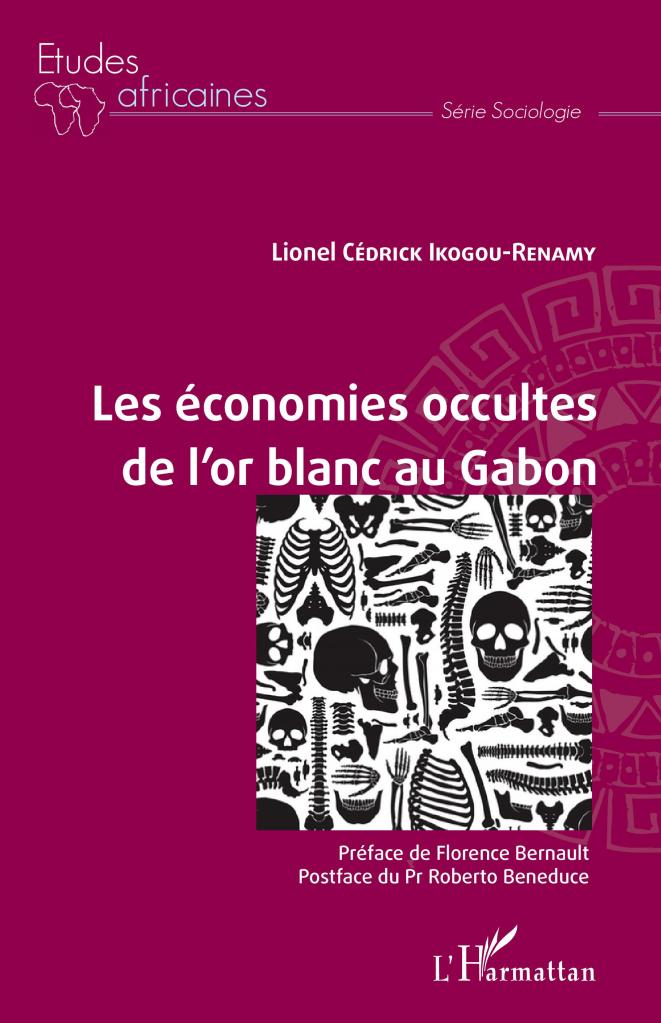
Excerpts from a conversation with Lionel Cédrick Ikogou-Renamy. Doctor of Anthropology, Omar Bongo University. Author of « Les économies occultes de l’or blanc au Gabon », 40 years old.
(from ‘The Ufo Issue in Central Africa’ by Jann Halexander, november 2023)
April 14, 2023
L.I-R : That’s a big question. As part of my research into the desecration of cemeteries, I could talk about will-o’-the-wisps. I had the experience when I was in the middle of a survey at around 8.10pm, 8.15pm, in Mindoubé. Then it happened. If you don’t know something at first, you’re scared, but then when you do, it gets better. The will-o’-the-wisps play on the imagination of Gabonese people.
J.H : In France we have « will-o’-the-wisp », but I have the impression that in Gabon it means something else?
L.I-R : It could be likened to a shooting star – it passes so quickly, just a few meters above the ground. Behind this will-o’-the-wisp is the mystical exit of a man, a sorcerer who wants to take over someone’s soul.
J.H : But in cemeteries, it’s due to the decomposition of organic matter.
L.I-R : Exactly. To go further, it’s the context that translates reality. You see, our context is one of suspicion and fear. There’s a lot of fear about other people. And there’s a sort of taboo.
J.H : A Congolese man told me that in Brazza, if someone sees something really strange, they keep quiet because talking about it could bring bad luck.
L.I-R : Absolutely. I’m in Port-Gentil, and I’ve heard about some rather incongruous situations. After that, I try to keep my perspective as a scientist, the anthropologist that I am. You have to detach yourself from a context that is fraught with taboos. We’re going to tell you what to do, lest you suffer reprisals because you’ve spoken out, or because you’ve seen, for example in a dream, the nocturnal exit of a sorcerer. For example, I can tell you that when a white owl passes through your area around 10 or 11 pm, it’s not a good sign. People will start shouting at the owl, « We’ve seen you, we’ve seen you, don’t bother hiding, we’ve seen you! » and immediately, perhaps inadvertently, it will change its trajectory. You’re tackling a complicated but interesting area.
J.H : In North America in particular, owls are often associated with extraterrestrials. Some ufologists have theorized that owls and deer are decoys. If, for example, you’re walking in the forest and you see a deer, and an hour later you find yourself at the edge of the forest and you don’t know how you got there – that’s called missing time – maybe the deer you saw wasn’t a deer at all, but an alien disguised so as not to shock you. It’s the same thing with owls.
L.I-R : It’s captivating. It really is. I’d like to come back to the question of taboo. When I was investigating cemeteries, a bwitist brother told me that people in the bwiti community were complaining because I was talking about things that were a bit secret. He defended me, saying I was just analyzing a phenomenon. It undoubtedly took a certain amount of courage for me to work on the economy of white gold, bones. But what you’re telling me makes me think. The owl, time running out, reminds me of an old lady, I think she’s still alive. She had a story about seeing an owl and then finding herself in a place where she wasn’t at first.
J.H : It’s very relevant. I’m not a ufologist, it’s really a state of affairs, it’s closer to anthropology. I’m very familiar with the story of the old lady, and there are similar stories in America and Europe.
L.I-R : Yes, that’s quite possible. People don’t talk easily.
J.H : There’s also the famous Issiki.

L.I-R : I was getting to that! I’ve seen it. I’m telling you. Without restraint. I even get goose bumps when I talk about it. I saw something else too, near the cemetery in the Plaine Niger district, Libreville’s fourth arrondissement, back in 1999, 2000. I was coming home late from the swimming pool, I’d taken a walk to the bank and I’d taken the unlit road next to the cemetery, next to some houses, which curiously didn’t have any lighting, and where I was, it wasn’t lit. And then, I assure you, I only told my mother and a few friends about it, a short distance from the crossroads where I could take the road to the Glass district, on the way up, I saw a white egg running. I thought I was going mad. A white egg with frog legs. I was completely stunned (silence on the phone). I didn’t tell my mother about it until two weeks later. She said, « Listen, you’ve got to learn not to go out at night anymore. ». At the time, I didn’t quite understand. Looking back, I think I witnessed a phenomenon whose ins and outs I can’t even begin to describe. As for Issiki, I saw him next to a cemetery – it’s always next to a cemetery in this kind of story, by the way – the Mindoubé cemetery. He was very small, smaller than a dwarf. He had long hair that swept across the ground like a wedding dress. He seemed to be looking for something on the ground. He looked at me, I looked at him, he smiled. Then he left. I didn’t get it. I don’t remember the skin color. He had a very blunt nose. His hair was very fine.
J.H : There were sightings of egg-shaped UFOs in Europe in the 50s. Maybe the legs you saw are some kind of mechanism that allows the object to move on the ground, but I’m speculating, quite frankly.
L.I-R : In any case, I avoided talking about it too much, so as not to come across as a nutcase.
J.H : Have the Gabonese media covered UFO news in recent years?
L.I-R : No. Not to my knowledge. For example, I’ve been reading L’Union for six years and I’ve seen nothing on the subject. That’s surprising, because the director of Sonapress, Gabon’s press company, is managed by a Frenchman. Even the satirical newspapers don’t mention it. It’s not easy. It’s easier for our media to talk about witchcraft, because it’s part of everyday life. We talk more about witchcraft and ghosts. In bwiti, they’ll tell you that the owl is an evil spirit. Like the bat, which has no right to come close to humans. I think back to the egg experience. I’m forty and it still gives me a chill when I talk about it. It’s time for Gabonese society to talk about these subjects. You’ve heard about Issiki since you were a child, so somewhere you’re prepared for it. But with the egg running, I felt like I was losing it.
***
Following exchanges with Lionel Cédrick Ikogou-Renamy.
He talks about the Mindoubé cemetery. When Librevillois (residents of Libreville) think of Mindoubé, they think of the notorious open-air landfill, which poses serious health and environmental problems. Nearby, however, is the municipal cemetery. The Plaine Niger district is located to the south of the capital, close to the seaside. Mindoubé is a little further south and inland.
A running egg? A long-haired dwarf searching for something on the ground at night? Hallucination? Bertrand Méheust, French writer, parapsychology specialist and former philosophy professor (he also worked as a cooperative teacher in Gabon in the late 70s) referred to these strange experiences as folklore. In his books ‘Science-fiction et soucoupes volantes – Une réalité mythico-physique’ (1978) and ‘Soucoupes Volantes et Folklore’ (1985), published by Mercure de France, he reduced the UFO phenomenon to a cultural illusion, without denigrating the fact that witnesses had actually experienced something. However, in an interview with the media outlet Pensée écologique published on June 7, 2023, he wrote : « But 76 years have passed since Kenneth Arnold*’s sighting, and the case still resists reduction. Better still, as I write these lines, NASA has just officially recognized a problem that has yet to find a solution.’ » The hypothesis had shown its limits.
* American aviator Kenneth Arnold was responsible for the first publicized sighting of ‘flying saucers’ on June 24, 1947. Although the existence of this phenomenon had been reported around the world for several centuries.




 UAP AFRIQUE
Laisser un commentaire