
Moloundou
Africa, a continent marked by age-old traditions and rich cultural diversity, is also characterised also stands out for its relative discretion when it comes to unidentified aerial phenomena (UAPs or UFOs). While the skies of Europe, America and Asia regularly record reports of these reports of these manifestations, Africa remains in the background, not because of a lack of activity, but often because of the cultural prism through which these phenomena are interpreted.
In sub-Saharan Africa, UFOs are frequently associated with spiritual or mystical beliefs, perceived as divine manifestations or acts of witchcraft. This unique look reflects the interplay between modernity and tradition. Among the many intriguing cases that of Moloundou, a remote village in eastern Cameroon, offers a fascinating perspective. Here, an isolated power station is said to have been disrupted by ‘mystical planes’, a phenomenon linked to accounts of UFOs and energy disturbances. This story sheds light not only on the the complex relationship between science, mysticism and modern infrastructure.
Located in the Boumba-et-Ngoko department, in the far south-east of Cameroon, the commune of Moloundou is an isolated locality in the heart of the dense equatorial forest. This landlocked arrondissement, which is difficult to access, embodies one of the most remote facets of Cameroon. One of the country’s most remote areas, where modern infrastructure struggles to hold its own against nature. The commune, bordered by stretches of virgin forest, is several hundred kilometres from the major urban centres. Hundreds of kilometres from major urban centres, accessible only by roads that are often impassable in the rainy season, or by river via the tributaries of the Congo River. This geographical isolation complicates economic development and access to essential services.
The Moloundou thermal power station, built in 1983 with an installed capacity of 570 kW, represents a rare window on modernity in a region still largely marked by the prevalence of traditional ways of life. Supplying power to a sparse population, it has become an essential pillar in the running of administrative services, schools and the few local economic activities. Local economic activities. However, due to its remoteness from the main industrial and consumer areas industrial and consumer areas, the plant operates autonomously, outside the interconnected national grid managed by Enéo, the major electricity operator in Cameroon.
In a region where electricity is still a privilege, this power station plays a vital role in meeting basic needs such as lighting and food preservation. However, its isolation makes its maintenance and fuel supply extremely complex. Spare parts, specialised technicians and fuel have to be transported from the main towns, a logistical challenge that generates high costs and intermittent maintenance.
Moloundou’s isolation also exacerbates its dependence on fragile infrastructure. Power cuts, often due to breakdowns or supply limitations, regularly plunge the town into a state of emergency, regularly plunge the town into darkness, compromising economic and social activities. This context makes people more vulnerable to mystical explanations for phenomena that which, elsewhere, could simply be attributed to technical causes.

The forest that surrounds Moloundou is more than just a natural setting: it is deeply linked to the beliefs of the local people, who see it as a sacred space inhabited by spirits and supernatural forces. This vision of the world is intertwined with the modern challenges posed by the operation of the thermal power plant of the power station. When unusual disturbances occur, such as the unexplained blackouts in
unexplained blackouts in 2014, they are often interpreted through the prism of local traditions.The coexistence of this modern infrastructure with a cultural context marked by spirituality and spirituality and mysticism gives Moloundou a unique dynamic, where science and tradition both confront and complement each other.
Ultimately, this enclave in the heart of the tropical forest illustrates the unique challenges posed by development of modern infrastructure in remote areas. The Moloundou power station, much more than a simple technical installation, becomes a symbol of the complex interactions between modernity, isolation and ancestral beliefs.
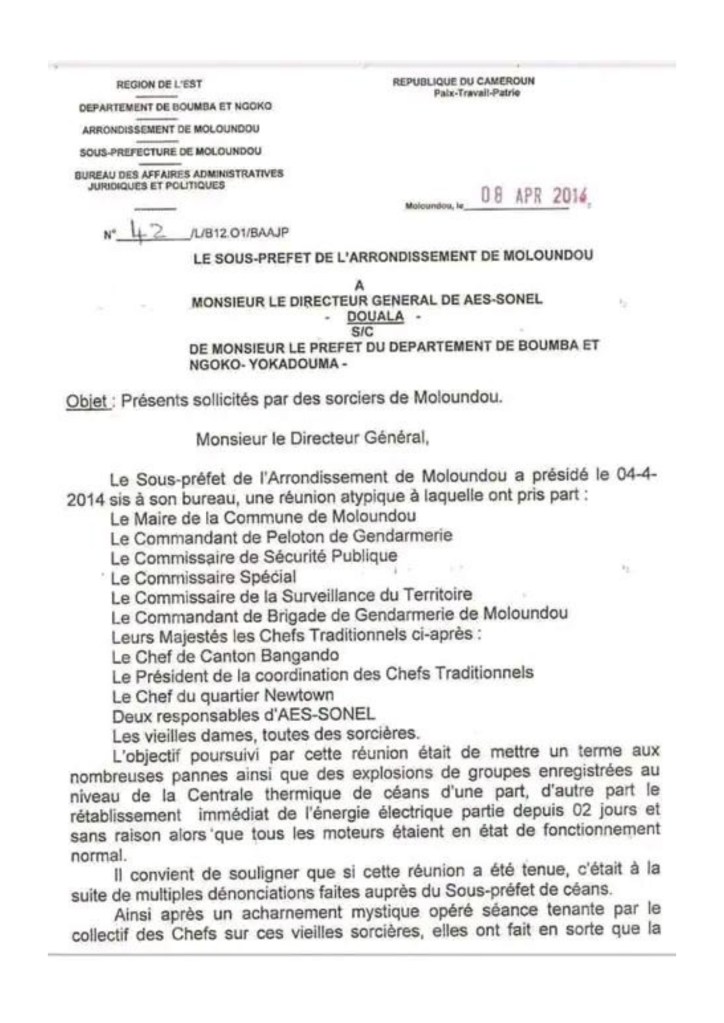
In April 2014, the Moloundou power station was the scene of a series of unusual events: repeated breakdowns and unexplained anomalies, even though all the equipment was deemed functional. These technical problems, prompted the local authorities to convenean unprecedented meeting.
Chaired by sub-prefect Avom Dang, the meeting brought together representatives of the company Enéo, traditional chiefs and even individuals identified as ‘witches’.
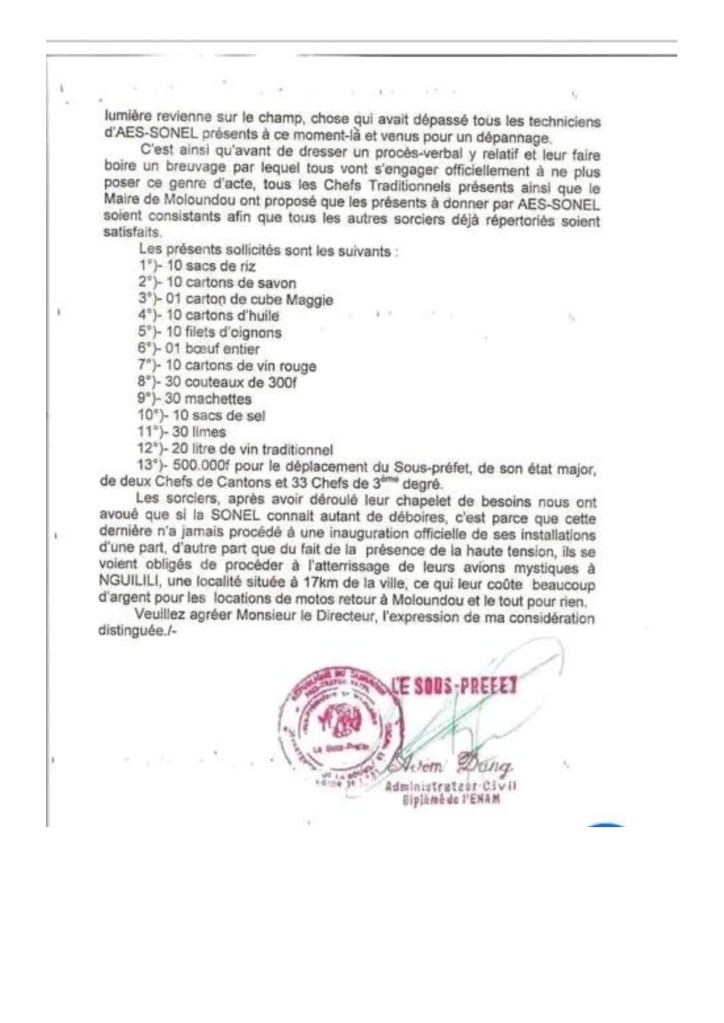
The disturbances were caused by ‘mystical planes’, supernatural entities whose movements in the sky had been disrupted by the plant’s electromagnetic fields.
fields of the power station. These planes, forced to land in Nguilili, a neighbouring town, would have caused the electrical malfunctions.
In many African cultures, UFOs are likened to spiritual manifestations. spiritual manifestations. In Moloundou, these phenomena were interpreted as mystical signs,
justifying rituals designed to ‘appease’ the disturbed forces. The solution recommended at this meeting meeting included a ceremony to inaugurate the electrical installations and give gifts to the ranging from foodstuffs to ritual tools. This approach, although approach, although surprising, would have enabled electricity to be restored quickly, where modern technicians had failed.
The case of Moloundou is not limited to its local context. Around the world, sightings of UFOs near electrical infrastructure are regularly reported. In the United States nuclear power stations and high-voltage power lines have been associated with power cuts or radar disturbances. In Europe, investigations by the SIGMA2 Commission have documented similar interactions, raising the question of possible energy
manipulation by these unidentified objects.
Scientific hypotheses
Researchers have put forward several theories to explain these interactions:
1. Energy access: UFOs could take advantage of the electromagnetic fields
generated by these infrastructures.
2. Secondary effects: The disturbances could be the unintended consequences of
of UFO propulsion or communication systems.
3. Human observation: These objects could simply be curious about human technologies.
Technologies.
Moloundou’s story highlights the tension between modernity and traditional beliefs
in the management of critical infrastructures. While the malfunctions have been resolved through rituals, they also highlight the limitations of conventional tools in contexts where culture plays an essential role. UFOs, beyond their mystery, become revelations of the relationship between local communities and technology.
The case of Moloundou invites us to look beyond prejudices and explore these phenomena from a wider perspective, combining scientific rigour with respect for local beliefs. UFOs, whether they are perceived as supernatural entities or extraterrestrial visitors, call into question our the importance of dialogue between cultures and disciplines. In an interconnected world, such stories could shed light on universal issues, from energy management to the place of humans in the universe.
N’Chi Coulibaly




 UAP AFRIQUE
Laisser un commentaire