
Hello Mr. Taylor, it’s an honor to interview you for UAP Afrique. You’re a professor at the John Jay College of Criminal Justice in New York, and you’re on the offensive on the issue of disclosure. Can you tell us a little more about your background and your origins for a French-speaking audience?
I live in New York and teach criminal justice. For me, the issue of UAPs (unidentified aerial phenomena) is really important to the world of public safety and criminal justice. It’s not just because of the history of the subject or the challenges it poses, but also because of everything it implies for the future – for society, and even for humanity in general.
I know that language barriers often make communication difficult, so I regularly share news with the French- and Spanish-speaking communities on X, even if most of the content is in English.

Lue Elizondo and Keith Louis Taylor
Why this interest in the UAP subject?
My interest in UAPs didn’t begin until 2017, after the New York Times article that talked about the reality of the phenomenon. From then on, I began to slowly investigate and educate myself: I bought books, watched documentaries, listened to interviews and podcasts… and realized that there was a huge amount of information out there that I was completely unaware of.
I also realized that I needed to be a megaphone for the law enforcement community, as they are historically the first to be called when UAP-related incidents occur. So, at the very least, they should receive appropriate training, be properly equipped, and have clear protocols for handling these situations safely – both for themselves and for the people they are sworn to protect.

UAP Afrique was founded in November 2023, among other things, to destroy the UFO cliché, a Western myth. How does the African-American community react to the UAP issue? I speak on a daily basis because culturally we see African-American filmmakers like Jordan Peele exploiting this subject.
I think the African-American community’s perspective on UAP reflects the broader values of American society: for the vast majority of people, it’s a subject we don’t think about, and when we do, we don’t really take it seriously.
And those who do dare to talk about it or take an interest in it often have a special connection with the subject – an experience, a landmark event, something that piqued their curiosity. But on the whole, whether among African-Americans or others, UAPs don’t really interest anyone, except perhaps for entertainment purposes.
On the other hand, as soon as we ask to be taken seriously by talking about this subject, there are almost always negative reactions: mockery, rejection, stigmatization. And that, unfortunately, hasn’t changed much since the subject has existed in the American consciousness – for seven or eight decades, at least.
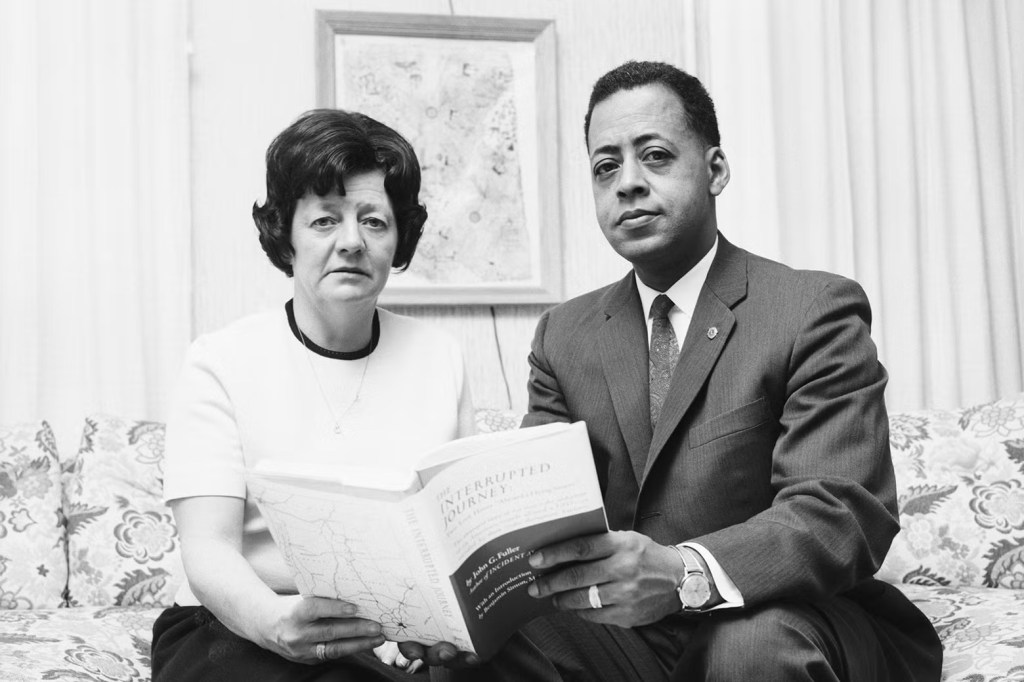
Famous interracial couple Betty and Barney Hill
We know that Experiencers of Color Collective exists. Are there any other initiatives in the African-American community related to the UAP issue?
I imagine that in different countries, with different cultures, there are various organizations or entities interested in the UAP issue. As far as the African-American community is concerned, there are undoubtedly initiatives – perhaps small, perhaps more informal – but I don’t think it’s very widespread yet, largely because of the general lack of interest within the community.
One positive aspect is that, thanks to social networks, geographical distance is no longer a real obstacle. People who share the same interests can meet, exchange and build together, no matter where they live. I think that’s what’s going to happen with organizations forming around the subject of UAP according to different affinity groups.
Lue Elizondo has entitled his book IMMINENT. Around the world, initiatives are multiplying to take a serious look at the UFO question. Do you think the noose is tightening? That something is happening or that, as the skeptics say, it’s a cycle and everything will fall back?
I think the noose is tightening, but at the same time, the knife to cut it is also being used. The recent Wall Street Journal article, which attempts to discredit people in the UAP community or witnesses with solid backgrounds and credible accounts of incredible things, is a good example.
The mere fact that this article was published shows that the old ways are still alive and well – those of the intelligence or defense communities trying, once again, to backtrack, to put the toothpaste back in the tube.
I think these attempts serve to divert attention from ultra-classified, even clandestine programs, which would deal with things like crash recovery, reverse engineering of technologies of unknown origin, or even biologics of unknown origin.
This kind of behavior – the diversion, the misinformation – will continue. Even if there were a global event, I’m sure there would be a disinformation campaign trying to exploit the situation for personal or strategic gain.
That’s why we absolutely have to keep up the effort to get disclosure, using different means: in academia, through whistleblowers, by putting pressure on governments to share this information with their citizens, and with the whole world.
And in the end, I hope that this global awareness will help humanity to reconnect, to rediscover what unites us, and to avoid – perhaps – some of the violence, death and destruction of which we are unfortunately capable as a species.



 UAP AFRIQUE
Laisser un commentaire