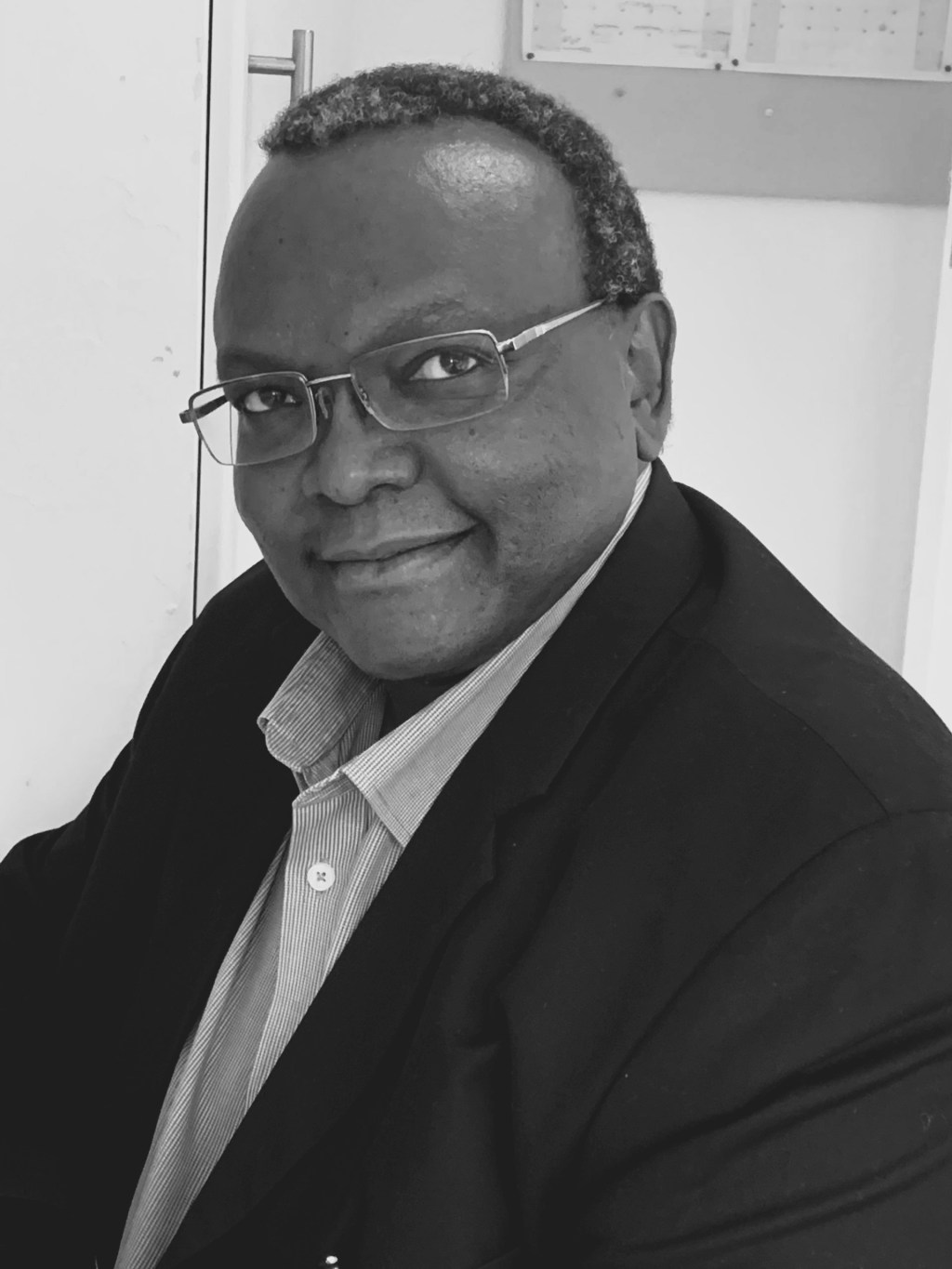

Tim Murithi (often referred to as Prof. Tim Murithi) is a renowned South African academic and expert in the fields of peace, international security, transitional justice and African relations. He heads the Peacebuilding Interventions programme at the Institute for Justice and Reconciliation (IJR) in Cape Town and holds the position of Extraordinary Professor of African Studies at the Centre for African and Gender Studies at the University of the Free State.
With over 25 years of experience, he has written or edited a dozen books (such as The Ethics of Peacebuilding and the Routledge Handbook of Africa’s International Relations) and hundreds of academic articles. His work focuses primarily on conflict resolution in Africa, the African Union and post-conflict reconciliation (he was notably involved in the post-apartheid processes).
Although it is not his main field of expertise, Professor Murithi has established himself since around 2020–2021 as a serious and respected researcher on the phenomenon of UFOs/UAPs. He is a member of the Society for UAP Studies and affiliated with the International Coalition for Extraterrestrial Research (ICER). He analyses the subject from an academic perspective, linking his expertise in peace and global governance to the issues surrounding disclosure.
He is regularly interviewed by the South African media (SABC News) to comment on official US reports on UAPs (notably the June 2021 report from the Office of the Director of National Intelligence and the videos confirmed by the US Navy). He has also participated in international podcasts, including a highly acclaimed episode of Dreamland (November 2025) entitled ‘Ancient and Modern UFOs in Africa’.
His main ideas and contributions Murithi insists that Africa is not on the margins of the UFO phenomenon, but has in fact been a central player for thousands of years. He cites the precise astronomical knowledge of the Dogon tribe (Mali) about Sirius B (known long before modern telescopes), ancient Egyptian myths related to ‘gods’ from the sky, and the Ariel School incident in Zimbabwe (1994), where hundreds of children reported seeing beings and a spacecraft (investigated by Harvard psychiatrist John Mack).
In his articles (notably ‘Reconnecting with our interstellar family’ published in 2021), he develops the ‘interstellar family’ hypothesis: UAPs are not invaders, but representatives of an advanced civilisation (or even galactic ‘parents’) seeking to reconnect with humanity to help us accept their existence. He bases this on recent official confirmations (NASA, Pentagon, ODNI reports) and on the fact that these phenomena often appear benevolent and non-threatening.
Above all, he advocates a peaceful and mature approach to disclosure: he compares the ‘truth embargo’ (the official secrecy surrounding UAPs) to apartheid and proposes applying a truth and reconciliation process (as in South Africa after 1994) to manage the psychological, cultural and geopolitical implications. He calls on governments, the media and citizens to prepare themselves mentally, to move away from stigmatisation and to organise open debates rather than giving in to fear or misinformation.
Africa has its place in global ufology. It is not on the periphery. And in English-speaking Africa, Tim Murithi is truly a leader on the UAP issue. In Africa, as in the rest of the world, many prominent figures from civil society, politics, business and science are speaking openly and freely on the subject, and in doing so are fighting against the stigmatisation of the subject, which must stop.
Tim Murithi is a credible intellectual who brings an original and humanistic African perspective to the debate on UFOs. He sees this phenomenon as an opportunity for humanity to grow collectively, overcoming earthly divisions through a broader awareness of our place in the universe.
Suggested reading


 UAP AFRIQUE
Laisser un commentaire